
Popular Casino Games Among Canadian Players: The Mechanics Behind the Odds

Slots are the largest single category Canadian players load up. The mechanics are forgiving. Low stakes, one button, a spin that resolves in seconds, and that combination explains the volume better than any payout table could. Table games and video poker pull a smaller, steadier crowd, players who like knowing exactly how the math works before they sit down. Every game covered here is built for a different tolerance, the way a low gear and a high gear both get a bike up the same hill, at different costs.
What Canadians Actually Sit Down and Play
The gap matters for something practical. That high-volume, low-friction crowd and the steadier table-game crowd aren’t just different sizes—they’re buying different things. A slot player spending five minutes on a phone is measuring success in spin speed and surprise. A blackjack grinder measuring basic strategy wants control and a known edge. The games that fill a lobby reflect that split, and the paytables, rules and odds in each game are tuned to match which one the player actually is.
Every game covered here trades speed and simplicity against strategic control, in a different ratio. Slots give speed. Blackjack gives control. Roulette and baccarat sit in the middle, no skill required, just a clear, published edge either way. Video poker is the odd one out, a slot machine a player can actually solve by learning the chart.
Slots: Reels, RTP and the Volatility Dial
A slot machine’s Return to Player, or RTP, is the percentage of every dollar wagered that the game mathematically pays back over a very large number of spins. It is a long-run average, calculated across millions of rounds, so a single short session can land far from it in either direction. Published online slot RTPs commonly sit in the 92% to 98% range. Land-based machines usually run lower, closer to 88% to 94%, because floor space and hardware cost more than server space does.
RTP tells you how much comes back over time. Volatility tells you how it comes back, and that second number matters more day to day than most players realize.
| Volatility | What it feels like | Who it suits |
| Low | Frequent small wins, few dry spells | Small bankrolls, longer sessions |
| Medium | Mixed pace, occasional mid-size hits | Most casual play |
| High | Long flat stretches, rare large hits | Bigger bankroll, shorter sessions, higher tolerance for zero |
I’ve run a low-volatility three-reel slot for twenty minutes and barely moved my balance in either direction. That flatness is the entire point of a low-volatility build. Switch to a high-volatility title and the same twenty minutes can swing hard in both directions before anything meaningful happens.
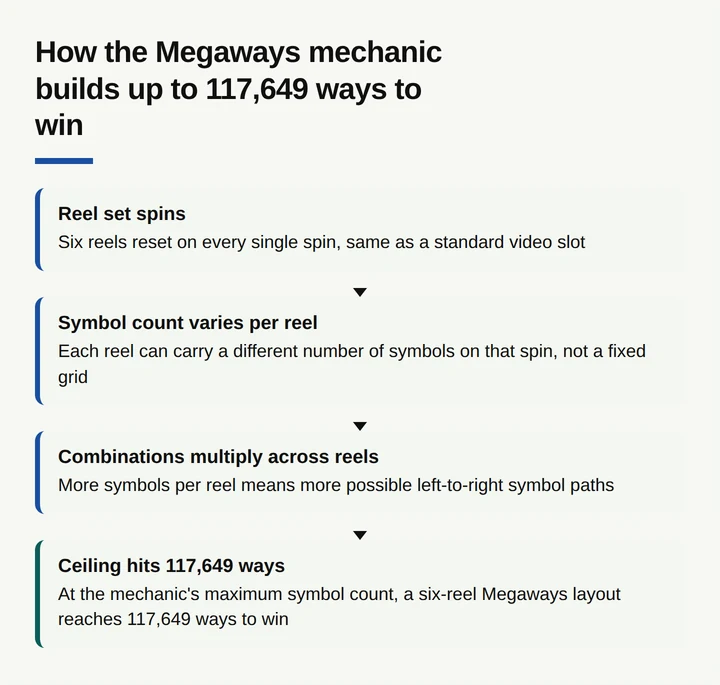
Big Time Gaming’s Megaways mechanic, first built for Bonanza in 2016, changed how volatility gets engineered. The number of symbols per reel varies on every spin, producing up to 117,649 ways to win on a six-reel layout. That is a mechanical trick for generating more symbol combinations per spin. That’s what makes Megaways titles read as high-volatility even before checking the paytable. Progressive jackpot slots work on a related mechanic that operates separately. A small slice of every wager across many machines or sites feeds a shared pool. That shared pool lets the ceiling on those games run well past a standard fixed-jackpot title, though the exact figure moves constantly and varies by network.
Blackjack: Why Basic Strategy Is the Only Lever That Matters
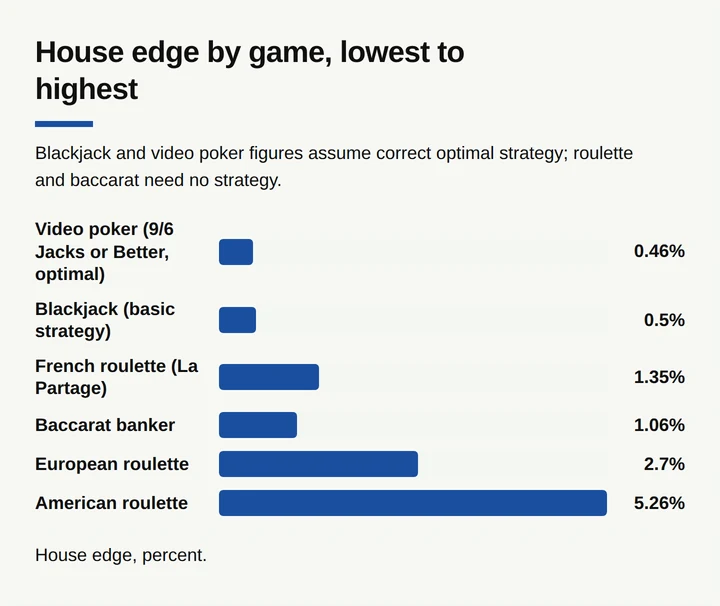
Blackjack’s house edge with correct basic strategy typically lands near 0.5%, sometimes falling under 1% depending on table rules. That range is the whole game, and casual players routinely skip the detail that moves it. Shoe count, the dealer’s rule on soft 17, and the blackjack payout ratio all shift that number meaningfully before a single card is dealt.
Three specific table rules decide how a session actually plays out:
- More decks in the shoe generally nudge the edge slightly toward the house.
- A dealer standing on soft 17 favors the player over a dealer who hits it.
- A 3:2 blackjack payout beats a 6:5 payout on the same bet, meaningfully.
I sat down at a live blackjack table once specifically to watch a dealer’s hands on soft 17, curious whether the table rule matched what the lobby description claimed. It did. The table rule actually moves the edge, even when the lobby doesn’t spell it out loudly.
Roulette: The Single Zero Changes Everything
European roulette, with a single zero, carries a 2.70% house edge. American roulette, with both a zero and a double zero, carries a 5.26% house edge, almost double. Same wheel concept, same bet types, nearly twice the cost to play over time, purely because of one extra pocket.
| Variant | Zeros | House edge |
| European | Single (0) | 2.70% |
| American | Double (0, 00) | 5.26% |
| French (with La Partage) | Single (0) | 1.35% |
French roulette adds a rule called La Partage, returning half the stake on even-money bets when the ball lands on zero. That single rule cuts the house edge to 1.35%, the best number on this table. It’s why serious roulette players specifically hunt for a French wheel, checking the rules card before sitting down every single time.
Baccarat: Banker Bet Wins the Math, Tie Bet Loses It
Baccarat has three bets on the table, and the odds on each vary sharply. The banker bet carries a house edge of about 1.06% after the standard 5% commission taken on winning banker bets. The player bet runs slightly worse at roughly 1.24%. The tie bet is the trap, sitting around a 14% house edge, a number that looks tempting on the payout board and performs terribly over any real sample size.
Betting banker every hand is mathematically optimal despite the commission bite. It’s a game with almost no decisions once you know that one fact. The appeal, for players who want table-game math without strategy homework, sits entirely in that simplicity.
Video Poker: A Slot Machine You Can Actually Solve
Video poker looks like a slot machine and pays out like a poker hand, and that hybrid is the whole appeal. Full-pay Jacks or Better returns 99.54% RTP when played with completely correct optimal strategy for every single hand. Its paytable carries the nickname 9/6, after the two payout multipliers that define it. Playing the same machine purely on instinct, skipping the strategy chart, typically drops the real return down toward 95% to 98%, still solid, well under the machine’s theoretical ceiling.
That gap between theoretical and actual return is the entire lesson of video poker. The machine rewards knowing which cards to hold on a marginal hand, over and over, hand after hand. Slots carry no equivalent lever at all. Blackjack offers a version of it. Video poker is the purest expression of the strategy chart being the difference, which draws a specific type of player, someone who treats a session like solving a puzzle.
Live Dealer Tables: Same Math, a Human Pace
Live dealer blackjack, roulette and baccarat run on the same underlying odds as their RNG counterparts. A human dealer at the table adds verification and pace to that math. Physical cards get shuffled and physical wheels get spun in a studio, multiple camera angles cover the table, and regulated studios like Evolution Gaming build fairness directly into that visible process.
That visible mechanism, watching the wheel stop and the card flip in real time, is the actual selling point for a lot of players. The pace is slower by design, built to feel like a physical casino floor. For players who want the math of the game paired with something they can literally see happen, that trade holds real value.
Where Canadians Are Actually Playing These Games
Canadian gambling traffic runs mobile-majority, and the gap is wide once real sites get checked individually against a single blended industry number. Semrush traffic data for major Canada-facing gambling domains shows a clear pattern.
| Site | Mobile traffic share |
| lotoquebec.com | 82.8% |
| olg.ca | 81.9% |
| stake.com | 67.8% |
All three sit above the roughly 65% floor that shows up across the category. Whatever the exact figure for any single operator, the direction is the same everywhere. A phone in hand beats a desktop browser for most Canadian sessions now.
That shift changes what actually matters in a game’s design. A high-volatility Megaways slot with a small screen and a thumb-driven interface has to load fast and resolve every spin cleanly, no lag between tap and reel stop. HTML5 handles that without an app download. That capability is most of the reason app-free mobile play became the default for slots, table games and video poker alike. For a closer look at how mobile casinos in Canada actually stack up on load speed and touch layout, that’s a good next stop before a real phone session.
Alberta’s Rules of the Road
Alberta gambling sits under AGLC, the Alberta Gaming, Liquor and Cannabis Commission. Play Alberta launched as the province’s own regulated online market in July 2026, making Alberta the second Canadian province after Ontario to run a provincially regulated online model.
That regulatory detail matters for the practical stuff. Game fairness testing, dispute resolution and responsible-gambling tools all route through a body a player can actually contact. GameSense, AGLC’s free responsible-gambling program, is the front door for that. Alberta’s Addiction Helpline runs free and confidential, around the clock. The number is 1-866-332-2322.
Picking a Game Like You’d Pick a Gear Ratio
None of these games are objectively “best.” They’re tuned for different rides. A commuter running ten minutes of low-stakes slots on a phone and a player grinding a long blackjack session on a known edge are optimizing for two entirely different sessions.
| Game | Typical house edge / RTP | Best suited to |
| Slots (standard) | ~92%-98% RTP | Short sessions, low stakes, no strategy required |
| Megaways slots | Same RTP range, higher volatility | Players comfortable with bigger swings |
| Blackjack (basic strategy) | ~0.5% house edge | Players willing to learn a strategy chart |
| European roulette | 2.70% house edge | Simple, no-skill table play |
| French roulette (La Partage) | 1.35% house edge | Same as European, better rule set |
| American roulette | 5.26% house edge | Avoid if a European or French wheel is available |
| Baccarat banker | 1.06% house edge | No-decision table play with a real edge |
| Baccarat tie | ~14% house edge | Skip it |
| Video poker (9/6 Jacks or Better, optimal play) | 99.54% RTP | Players who want a solvable game |
Read that table the way you’d read a gear chart before a climb. Lower numbers cost less over distance, higher numbers move faster with more risk of stalling out. Match the game to the session actually wanted, and skip whatever the lobby’s front page happens to push hardest.
FAQ
What is the most popular casino game in Canada?
Slots are the largest category by a clear margin, mostly on account of low stakes and simple mechanics. Megaways titles and progressive jackpot slots tend to draw the most attention within that category because of their higher ceilings and bigger volatility swings.
Which casino games offer the best odds for players?
Blackjack with correct basic strategy typically runs a house edge near 0.5%, sometimes under 1% depending on table rules. Baccarat’s banker bet sits at about 1.06%, close behind it. Full-pay Jacks or Better video poker returns 99.54% RTP with completely correct optimal strategy, the strongest number on this list, but only if every hand gets played by the chart.
What does RTP actually mean?
Return to Player is the percentage of every dollar wagered a game is mathematically built to pay back over a very large number of rounds. A 96% RTP game is built to return that share of every dollar wagered as a long-run average across many sessions, never a guarantee for any one sitting.
Does European roulette actually beat American roulette on odds?
Yes, mathematically, every time. European roulette’s single zero gives a 2.70% house edge against American roulette’s 5.26% with the added double zero. French roulette with La Partage cuts that further to 1.35%. Given a choice of wheels, the single-zero table is always the stronger pick.
Are live dealer games actually fair?
Yes. Live dealer tables use physical cards and wheels handled by a real dealer in a regulated studio, covered by multiple camera angles, running the same underlying house edge as the RNG version of the same game. The fairness mechanism sits in plain view, physical objects moving on camera. That visibility draws players who want to watch the process itself.
Can I play these games on my phone in Canada?
Yes, and most Canadian sessions already happen that way. Major Canada-facing gambling sites run mobile-majority traffic, with lotoquebec.com and olg.ca both clearing 80% mobile share. HTML5 handles slots, table games and video poker directly in a mobile browser, no app download required.
How does the Megaways mechanic actually work?
Big Time Gaming’s Megaways system varies the symbol count on every reel on every spin, producing up to 117,649 possible ways to win on a six-reel layout. It’s a mechanical trick for generating volatility, first built for Bonanza in 2016. It describes how many ways a spin can win, nothing about what any single spin actually pays.
Why is the baccarat tie bet a bad idea?
The tie bet’s house edge runs around 14%. Both the banker and player bets sit near 1%. That gap alone is why serious baccarat players skip the tie no matter how the payout board tries to sell it. Its long odds pay out big on paper, but the bet hits rarely, a classic sign of a weak wager on any table.