
How Slot Machines Actually Pay: RTP, Volatility, and the Math Behind the Reels

A slot’s payout behavior comes down to two independent numbers. RTP, short for return to player, is the share of wagered money a game returns over the long run. Volatility shapes how unevenly the game spreads those returns from spin to spin. Two games with an identical RTP can play at completely different rhythms, because volatility governs the size and timing of individual wins. A certified random number generator sits behind both figures, running every spin on its own. No hunches, no “hot machine,” no lever to pull that changes the odds.
What RTP Actually Measures
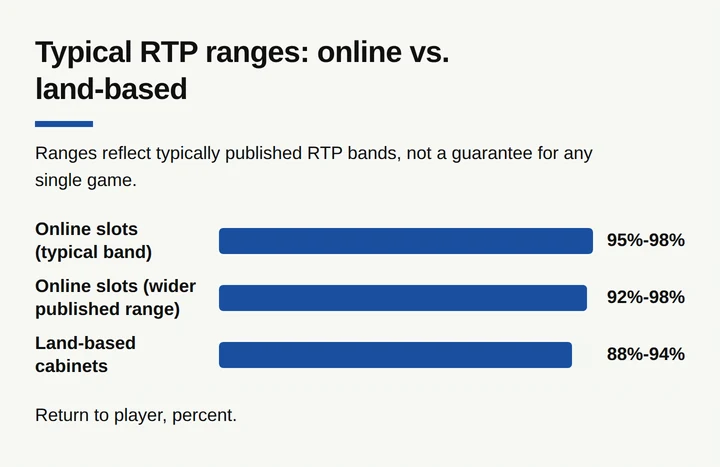
RTP describes the long-run payback across thousands or millions of spins. A twenty-minute session is only a tiny snapshot of that calculation. Online slot RTP commonly sits in the 95%-98% range. The wider published spread reaches roughly 92%-98% depending on the game and jurisdiction. Land-based cabinets tend to run lower, often in the 88%-94% band. A physical machine carries a fixed operating cost spread across one casino floor. An online game spreads that same kind of cost across a player base numbering in the thousands.
A quoted RTP describes the machine’s long-run design. Across millions of spins logged by the game’s math model, the theoretical payback settles at that level. Your own session might return 40%, might return 200%, and both outcomes are consistent with the same long-run figure. A single session only ever samples a small slice of the spins behind that number.
In the UK, the Gambling Commission publishes guidance on live RTP performance monitoring for games of chance, treating RTP as a measured, regulator-tracked figure. It’s a live metric monitored continuously, with ongoing audits after launch. That framework exists because RTP is checkable against real spin data, and regulators check it.
Casual slots talk regularly conflates theoretical RTP with what a single player experiences in a session. Theoretical RTP is a property of the game’s math model, calculated by the studio and verified by an independent lab before launch. What you experience in a given hour is one small sample pulled from that model. Small samples swing hard in both directions. Averages settle near the long-run figure only once enough spins pile up behind them.
Volatility Decides How the 96% Actually Feels
Volatility is what creates the sensation of play even when two slots share the same RTP. Low-volatility games deliver frequent small payouts, extending session time with consistent feedback. High-volatility games deliver sparse payouts that can swing much larger.
According to Borgata’s breakdown of high- versus low-volatility play, a high-variance slot burns through stake quickly, often within an hour. A low-variance slot stretches the same stake into a multi-hour session. That gap illustrates how volatility determines how long identical money lasts, purely from variance, with no change to the underlying RTP at all.
Low and high volatility diverge most sharply here:
| Volatility | Typical biggest-win multiple | Session behavior |
| Low | 250x-500x the bet | Frequent small/medium wins, longer play time per dollar |
| High | 3,000x-10,000x the bet | Rare wins, occasional very large payouts, faster bankroll swings |
Neither profile is objectively better. A marathon session with modest ups and downs calls for low volatility. A shot at a life-changing multiplier, accepted alongside long dry stretches, calls for high volatility. The key is matching your game choice to your session goals and bankroll.
Most slots in a lobby sit somewhere in the middle. A medium-volatility game blends both patterns. Wins land often enough to keep a session moving, and the occasional payout runs well above the smallest low-volatility hits. Many players default to medium volatility while they’re still learning their own preference, since the format is forgiving of an unfamiliar bankroll.
Why RTP and Volatility Have to Be Read Together
You need both RTP and volatility to understand slot behavior. RTP tells you the destination over the long run. Volatility tells you how bumpy the road is to get there. A low-volatility slot at a baseline RTP unfolds as a steady progression of small wins. A high-volatility slot at the same RTP delivers long dry spells punctuated by substantial payouts. The payback total remains the same; only the rhythm changes.
Comparing two slots purely on advertised RTP percentage overlooks session length and bankroll size. A player with $50 and 30 minutes to play needs the volatility profile alongside the RTP number, because volatility determines whether that $50 survives long enough to matter.
Progressive Jackpots Trade Base RTP for a Shot at the Pool
Progressive jackpot slots carry a lower base-game RTP than their non-progressive counterparts, for a simple mechanical reason: a slice of every wager goes into the growing jackpot pool, removing it from the base payout math. Industry sourcing commonly puts that diversion around 0.5%-2% of each bet, which is sometimes framed as shaving several percentage points off what would otherwise be a typical baseline RTP.
The design of progressive slots trades everyday payback for jackpot growth. A portion of every wager is diverted into the growing jackpot pool, leaving less behind for the base payout. Playing a progressive means funding the possibility of a life-changing win at a reduced base rate. That framework is transparent by design and worth understanding before treating a progressive like a standard slot with a bonus layer.

What a Certified RNG Actually Checks
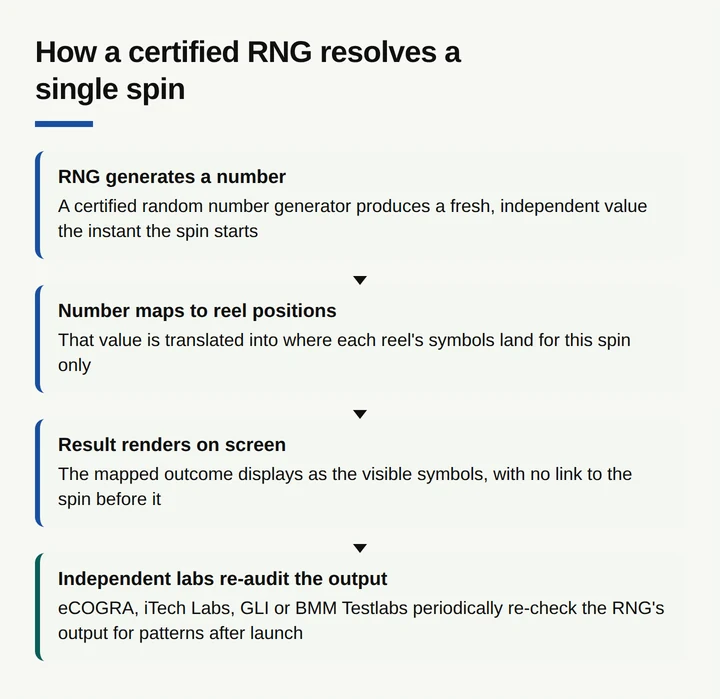
The random number generator is the part of a slot that makes every spin statistically unrelated to the one before it. Independent testing labs, including eCOGRA, iTech Labs, GLI, and BMM Testlabs, certify slot RNGs before a game ever reaches a casino floor or an online lobby. That certification isn’t a rubber stamp. It typically covers source-code review, statistical analysis of RNG output across a very large number of iterations, checks on how the seed values are generated, and periodic re-audits once the game is live. No amount of button-timing, “warming up” a machine, or switching seats changes what the RNG produces next. Every certified slot is running the same math whether it’s your first spin of the day or your five-hundredth. If a game’s RNG hasn’t been through this kind of lab certification, treat that as a real red flag about the operator worth checking before you play there.
Matching a Slot to How You Actually Play
Picking a slot starts with matching a game’s profile to your session goals and bankroll. Short sessions with limited bankroll call for low volatility and RTP toward the higher end. Long sessions where you’re comfortable with dry spells suit high volatility, trading frequent wins for bigger potential payouts. Chasing a life-changing number points to progressive jackpot slots, which deliberately trade lower everyday payback for the jackpot pool. Testing a new game works best in demo or lowest-stake mode to feel the volatility before real bankroll commitment. Across any approach, set a loss limit and a time limit before you start, treating both as non-negotiable.
None of this changes the underlying math. It lines your expectations up with a game’s actual design before you sit down to play.
Studios usually publish a volatility rating alongside the RTP figure, often on a simple low/medium/high scale, sometimes shown as a star rating or a bar graph in the game’s info screen. That rating is worth checking before you load real money into an unfamiliar title. Ten seconds spent reading it tells you more about what a session will feel like than the RTP number alone.
Myths That Keep Circulating (and Why They’re Wrong)
A few beliefs about slot machines remain common, even though they’ve been researched and tested repeatedly.
“You can feel when a machine is due.” Research out of UNLV’s gaming studies program found that players cannot reliably detect differences in payout percentages between machines, even when those differences were real and measurable in the study. If trained observers under test conditions can’t feel RTP by playing, casual intuition about a machine being “due” doesn’t hold up either.
“Machines run hot or cold based on time of day.” A certified RNG has no clock input tied to payout behavior. Spin outcomes aren’t scheduled around foot traffic or the hour.
“Higher bets unlock better odds.” Bet size changes how much you can win per spin; it doesn’t change the RTP or the RNG’s underlying probabilities. A $1 spin and a $5 spin on the same game run on identical odds, scaled by stake.
“A near-miss means a win is close.” Reel symbols landing just above or below a payline are a visual design choice with no bearing on the next spin. The RNG has already determined the next outcome independently of how the previous one looked on screen.
Playing Within Your Limits in Alberta
Slot mechanics are worth understanding, but they don’t replace a plan for how much time and money you’re willing to spend. In Alberta, gambling is regulated by AGLC (Alberta Gaming, Liquor and Cannabis), and Play Alberta is the province’s regulated online gambling market. That regulatory layer is part of why RTP figures, RNG certification, and licensing checks matter here specifically rather than as abstract fairness talk.
If slot play stops feeling like entertainment with a fixed budget, GameSense (gamesense.ca) is AGLC’s free responsible-gambling program, built for exactly that moment. The Alberta Addiction Helpline, 1-866-332-2322, is free, confidential, and available 24/7. This content is for players 18 and older; understanding RTP and volatility is a tool for informed play, and it doesn’t guarantee outcomes.
FAQ
Does a higher RTP mean I’ll win more often?
RTP and win frequency answer different questions. RTP measures long-run payback, while win frequency is a volatility trait. A low-volatility slot with a modest RTP can pay more often than a high-volatility slot with a slightly higher RTP.
Can a casino change a slot’s RTP after it’s live?
Individual games typically ship with a fixed, certified RTP setting per version. Any change would alter the certified math model, which is exactly what regulators like the UK Gambling Commission track through RTP performance monitoring that continues well past the game’s launch.
Is volatility the same thing as risk?
Volatility describes how a game’s payout distribution is shaped. Risk depends on your bankroll, bet size, and session length relative to that distribution. A small bankroll carries more risk on a high-volatility slot than a large one does, on the same game with the same volatility rating.
Why do progressive jackpot slots feel like they pay less normally?
Because they usually do. A share of each wager funds the jackpot pool, shrinking what’s left for the base-game payout table and lowering everyday RTP in exchange for a shot at the growing prize. That’s a designed tradeoff built into how the game funds its jackpot.
Do faster spins or auto-play change my odds?
No. Spin speed and auto-play only affect how many spins you get through in a given time; the RNG produces the same independent, certified odds on every single spin regardless of pace.
Are online slots RNGs actually tested, or is that just marketing language?
They’re tested by independent labs such as eCOGRA, iTech Labs, GLI, and BMM Testlabs, which review source code, run statistical analysis on RNG output, and re-audit games periodically after launch. A lack of any such certification on a given operator is worth checking before you play there.
Why do land-based machines often have lower RTP than online slots?
Physical cabinets carry higher per-unit operating costs than an online game served to a large player base, which tends to push land-based RTP toward the lower end of the typical 88%-94% range compared to the higher online range.
Is there any way to predict which spin will hit?
No. Certified RNGs generate outcomes independently of prior spins, bet history, or time of day. Betting systems built around “predicting” a hit are working against math that has no memory to exploit. Tracking your own spin history won’t reveal a pattern, because none exists for the RNG to follow.