
Slots vs Table Games: Key Differences Explained

I’ve spent enough time at both slot machines and table games to know they’re fundamentally different animals. Slots are fast, solitary, and driven entirely by chance. You press a button and the reels spin, no decisions required. Table games like blackjack, baccarat, and craps run at a fraction of a slot’s pace, involve real choices, and often carry a lower house edge. If you want pure speed and sensory overload, slots win. If you prefer strategy, social interaction, and better odds, table games are the smarter play.
What I Tested
I played multiple spins on a high-volatility slot (Book of Dead), along with hands of blackjack using basic strategy, rounds of baccarat betting the banker, and European roulette. I tracked time per session, decisions per hour, and how my bankroll moved. I also played live dealer blackjack to gauge the social dynamic.
Gameplay Mechanics and Speed
Slots are built for speed, with each spin taking just a handful of seconds. That means you can play through hundreds of rounds in an hour. Table games run at a much slower cadence. A single hand of blackjack or spin of the roulette wheel can take several minutes from start to finish. The difference is like comparing a sprint to a marathon.
I found the slot pace captivating and draining simultaneously. After just a few minutes of Book of Dead, my thumb was sore from tapping the spin button, and I’d already burned through $50. At the blackjack table, the same $50 lasted over an hour because I had time to think between hands. The slower rhythm gave me room to breathe and to make better decisions.
If you want a quick dopamine hit, slots deliver. If you prefer a measured, deliberate session, table games are your match.
House Edge and Odds Comparison
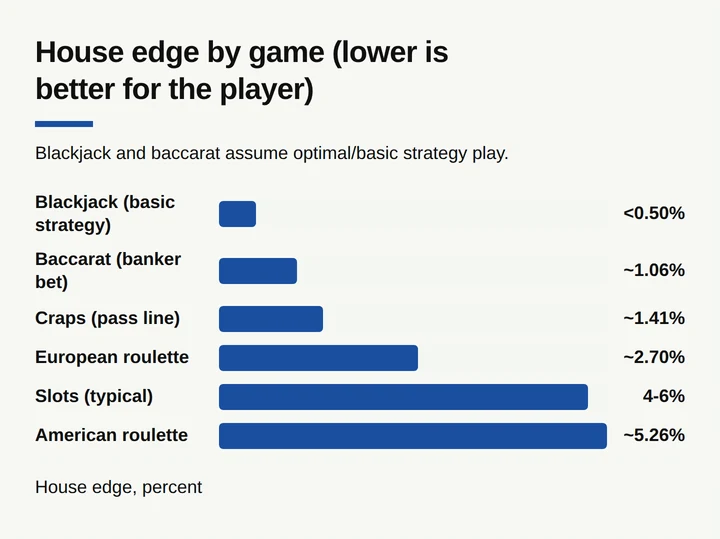
Table games offer lower house edges. The house edge for most table games is significantly lower than slots, assuming you play with basic strategy.
| Game | House Edge | Notes |
|---|---|---|
| European roulette (single zero) | ~2.70% | One zero pocket |
| American roulette (double zero) | ~5.26% | Two zero pockets |
| Blackjack (basic strategy) | <0.50% | Depends on rules |
| Baccarat (banker bet) | ~1.06% | Commission applies |
| Craps (pass line) | ~1.41% | Simple bet |
| Slot machines (typical) | 4–6% | Range 2–10% |
I tested blackjack with basic strategy and lost only $2 over a handful of hands, a 10% loss on a tiny sample. The theoretical math shows I should lose less than 0.5% over thousands of hands. Slot machines drain your bankroll faster. Slot RTPs vary by title and jurisdiction, and the UK Gambling Commission publishes guidance on how operators are expected to monitor actual RTP performance against the theoretical figure the game was designed with.
If you care about long-term value, table games offer lower house edges and better return rates.
Skill Requirements and Strategy Depth
Not all table games demand the same skill level:
- Slots: Zero skill. Press spin, hope for the best. No decisions, no strategy.
- Roulette: Minimal skill. You pick a number or color, the wheel decides. Betting systems don’t change the house edge.
- Baccarat: Low skill. You bet on player, banker, or tie. The banker bet has the best odds. No decisions after the bet.
- Blackjack: Moderate skill. Basic strategy reduces the house edge to under 0.5%. Card counting is possible but impractical in most casinos.
- Poker (casino variants): High skill. Texas Hold’em against the house or other players requires reading opponents, managing pot odds, and bluffing.
I learned blackjack basic strategy from a free online chart in a short time. Discipline matters most, especially when the dealer shows a face card and you’re tempted to hit on 16. I stuck to the chart and felt in control, even when I lost. Slots offer no such illusion of control.
Social Interaction Differences
Slots are a solo activity. You sit in front of a machine, headphones on, and the only interaction is with the screen. Table games, especially live dealer versions, are inherently social. At the blackjack table, I chatted with the dealer and the player next to me. We commiserated over bad hands and celebrated wins together.
This social dimension matters more than I expected. The blackjack table felt like a shared experience. The slot machine felt like a private transaction. Table games appeal to people who value contact with dealers and other players. Slots appeal to those who prefer solo play.
Live dealer games online offer some social interaction via chat. This differs from sitting at a physical table. If you’re playing from home, slots match table games in isolation on a screen.
Betting Flexibility
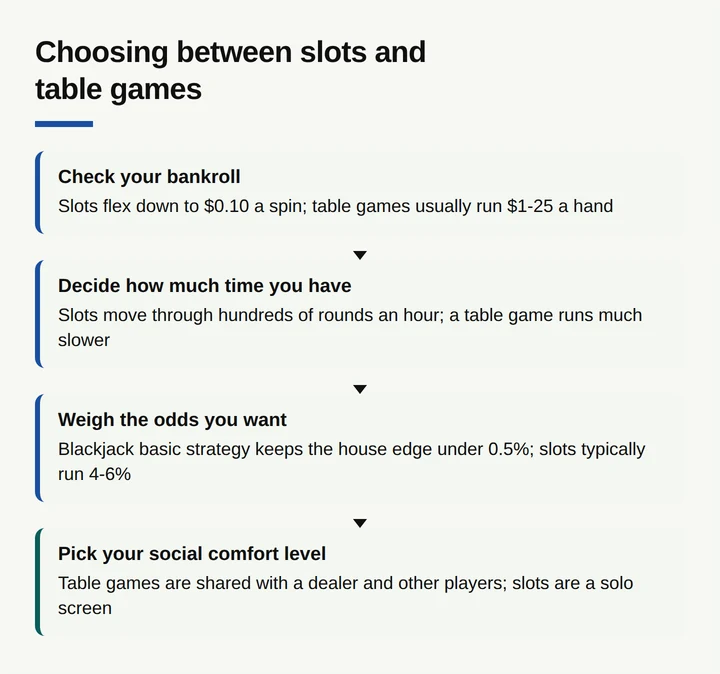
Slots win on low minimum bets. I’ve played slots for as little as $0.10 per spin. Table games typically require $1–$25 minimum bets, depending on the casino and time of day. At a $5 minimum blackjack table, you need at least $100 to survive variance for an hour.
I tested both ends. A $0.20 slot spin and a $5 blackjack hand showed the difference. The slot let me stretch my bankroll across dozens of spins, while the blackjack hand felt like a real commitment. For casual players on a tight budget, slots offer more flexibility. Serious players seeking to maximize value need a bigger bankroll to access table games’ superior returns.
Volatility and Bankroll Impact
Volatility measures how much your bankroll swings during play. High-volatility slots can drain your balance quickly but offer the chance for big wins. Low-volatility slots pay out small amounts frequently. Table games have their own volatility patterns.
Bankroll considerations by game type:
- High-volatility slots: Expect long dry spells. Bankroll guidance suggests 200–300x your bet size to survive variance. I lost 15 spins in a row on Book of Dead before hitting a 50x win.
- Low-volatility slots: Smaller, more frequent wins. Your bankroll lasts longer, but you won’t hit life-changing jackpots.
- Blackjack: Low volatility if you use basic strategy. Losses are gradual, and you can play for hours on a modest bankroll.
- Roulette: Medium volatility. Betting on single numbers is high-risk; betting on red/black is low-risk but pays even money.
- Baccarat: Low volatility on banker bet. The house edge is small, so your bankroll erodes slowly.
I prefer low-volatility games because I hate watching my balance drop. If you’re the type who can handle a 20-spin losing streak for a shot at a 500x win, high-volatility slots are your game.
Learning Curves
Slots have no learning curve. Anyone can sit down and play. Table games require at least a basic understanding of rules and strategy. Even with a quick study session, I still made mistakes under pressure. Roulette is simpler. Pick a bet, place chips, wait for the wheel. Baccarat is even simpler. Just choose player or banker.
My advice: If you’re new to casino games, start with slots or roulette. Graduate to blackjack once you’re comfortable with the pace and rules. Poker is a separate skill set entirely.
My Take on Slots vs Table Games
Neither category is objectively better. Slots suit those looking for quick entertainment, sensory stimulation, and low minimum bets. Table games appeal to players who prefer strategy, social interaction, and better mathematical odds.
I personally lean toward table games because I enjoy the mental engagement of blackjack and the social atmosphere of a live dealer table. I also understand the appeal of slots for those seeking pure entertainment without thought. Match the experience to your mood.
Final advice: Try both with small stakes. Play several spins on a slot, then several hands of blackjack. See which one feels better. Your bankroll and your enjoyment will tell you the answer.
FAQ
Are slots or table games better for beginners?
Slots are easier to start with because there’s no strategy to learn. Table games like roulette and baccarat are also beginner-friendly, but blackjack requires studying basic strategy first.
Which game has the best odds for the player?
Blackjack with basic strategy offers the lowest house edge (under 0.5%). Baccarat banker bet (1.06%) and craps pass line (1.41%) are also strong options.
Can you win real money playing slots?
Yes. The house edge is higher than table games, which limits earning potential. Slots work best as entertainment.
Do table games require more skill than slots?
Yes. Slots are pure chance. Table games like blackjack and poker involve strategy that can reduce the house edge or give you an edge over other players.
Which game is more social?
Table games, especially live dealer versions, offer more interaction with dealers and other players. Slots are a solo experience.
What’s the minimum bet for table games?
Typically $1–$25 per hand, depending on the casino and table limits. Slots can be played for as little as $0.10 per spin.
How does volatility affect my bankroll?
High-volatility games drain your bankroll faster but offer bigger potential wins. Low-volatility games provide smaller, more frequent payouts.
Is it better to play slots or table games online?
It depends on your goals. Slots are faster and more accessible. Table games offer better odds and more engagement.
Responsible gambling reminder: All casino games are designed to favor the house. Set a budget, stick to it, and never chase losses. If you or someone you know needs help, contact the Alberta Addiction Helpline at 1-866-332-2322 or visit GameSense for free, confidential support. See our playing safely guide for more. You must be 18 or older to gamble in Alberta.